

09Sep
2 Stroke vs 4 Stroke Outboard: Fuel, Oil, Weight & Maintenance
2 Stroke vs 4 Stroke Outboard: Fuel, Oil, Weight & Maintenance Compared

The two-stroke versus four-stroke debate has divided boaters for fifty years, and it isn’t finished yet. Ask at any marina and you’ll hear both cases argued with religious conviction — the two-stroke loyalist swears by the snap off the line, the four-stroke convert swears by the silence at the sandbar. The truth, as usual, depends on how you use your boat. This guide compares the two designs on fuel, oil, weight, noise, maintenance, and longevity — and explains why modern direct injection quietly rewrote the rulebook.
How the Two Engines Actually Differ

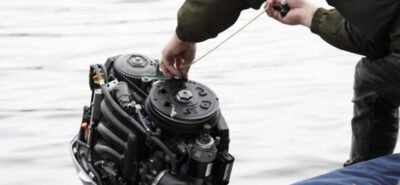
A four-stroke completes its combustion cycle in four piston movements: intake, compression, power, exhaust. Valves open and close precisely; fresh air and fuel enter only through the intake, and exhaust leaves only through the exhaust port. Clean, complete, controlled — at the cost of more moving parts (camshafts, valves, valve springs, timing gear) and roughly double the engine’s physical size for a given power.
A two-stroke completes a combustion event every crankshaft revolution — a power stroke on every down-stroke. Historically it did this with ports in the cylinder wall itself: the rising and falling piston alternately covered and uncovered intake and exhaust openings, drawing fresh mixture in and pushing spent gases out in a single sweep. Fewer parts, less weight, more power per cc — but the old port design inevitably pushed unburned fuel out with the exhaust, which is where every classic two-stroke problem comes from.
Fuel Economy: The Four-Stroke’s Home Turf
Here the numbers are not close. A carbureted or traditional two-stroke outboard burns roughly 30–50% more fuel than a modern four-stroke of the same horsepower at cruise, because the port design scavenges raw fuel straight into the exhaust on every cycle. A 150 HP four-stroke will burn around 7–8 gallons per hour at 3500 RPM where a comparable old-tech two-stroke burns 11–12.
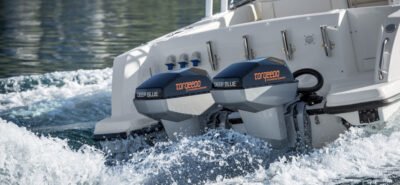
But there is a critical exception: direct-injection two-strokes. Engines like the Evinrude E-TEC spray fuel into the cylinder after the exhaust port has closed — eliminating the scavenging loss entirely. Independent tests repeatedly showed E-TEC matching or beating four-stroke fuel economy at cruise, while two-strokes retained their characteristic low-end punch. That’s why the “two-strokes always drink” argument no longer holds against a DI engine.
Oil: Mixing vs Self-Contained
This is the daily-use difference most owners actually feel:
-
Traditional two-stroke: You mix oil into the fuel (or feed it from an oil-injection tank). Every drop of oil you buy is burned and exhausted — roughly one litre of oil per 50 litres of fuel. Blue haze at idle, an oil slick behind the boat at the no-wake zone, and a constant supply of two-stroke oil on the shopping list.
-
Four-stroke: Oil lives in a crankcase sump like your car’s engine and is reused for hundreds of hours. Top-ups between services are minimal; there is no smoke, no slick, and no premix jug.
-
Direct-injection two-stroke (E-TEC): Still burns oil, but at dramatically lower rates — and E-TEC engines were engineered around long service intervals: no dealer-scheduled maintenance for the first three years or 300 hours, whichever comes first.
If you boat on a lake with environmental restrictions, note that many EU and US waters now restrict carbureted two-strokes specifically because of the oil-in-exhaust issue — a four-stroke or DI two-stroke is effectively the compliant choice.
Weight: The Two-Stroke’s Last Stronghold
Physics still favors the two-stroke here. With roughly half the moving parts and no valve train, a two-stroke powerhead is lighter and more compact. Historically that meant a 15 kg difference on a 150 HP transom — significant when you’re hand-lifting a portable onto a RIB, and valuable on weight-sensitive bass and flats boats where every kilo aft matters.
Modern four-strokes have closed most of that gap: today’s 150 HP four-strokes weigh within a few kilos of the old carbureted two-strokes they replaced, thanks to plasma-fused cylinders, compact DOHC heads, and composite intakes. In the portable class (4–25 HP), the difference is now small enough that portability is decided by carry handles more than engine architecture.
Noise, Vibration & Smoke
Walk past a boat idling on a carbureted two-stroke and your nose tells you everything: unburned fuel, burned oil, and a rattly, high-frequency exhaust note. Four-strokes idle with a subdued automotive burble and produce no visible smoke at any speed.
Direct-injection two-strokes sit between the old caricature and the four-stroke: at cruise, an E-TEC is barely distinguishable from a four-stroke in noise or smoke; at idle there’s still a faint two-stroke chirrup — which some boaters genuinely love. If silent trolling past a fish spot is your priority, four-stroke wins outright.
Maintenance: Fewer Parts vs Simpler Servicing
The comparison most buyers get wrong:
Two-stroke advantages: No valve adjustments, no cam belts, no oil filters, no spark-plug wells full of carbon sludge. The engine is mechanically simpler, and winterizing means fogging the cylinders and draining the fuel — a job done in 20 minutes with the engine on the transom.
Four-stroke advantages: No oil to mix, far longer spark-plug life, no exhaust power-valve gumming, and the crankcase oil does its lubricating in a closed system where it can actually be filtered. Scheduled service is more involved (valve clearance checks every 300–500 hours on some models) but the engine tolerates neglect between services better than a two-stroke tolerates the wrong oil ratio.
The E-TEC wildcard: Direct injection brought two-stroke servicing full circle. BRP’s E-TEC lineup was engineered around minimal scheduled maintenance — no break-in oil changes, no scheduled dealer visits for three years/300 hours, and components lubricated for the duty cycle. In ownership studies, that made the modern DI two-stroke the lowest-maintenance architecture on the water, combining two-stroke simplicity with four-stroke cleanliness. One caveat for used buyers: E-TEC engines require XD100 or TC-W3RL certified oil — using the wrong oil can damage the direct-injection system.
Reliability & Longevity
Both architectures, properly maintained, will outlast the boat. The failure modes differ:
-
Two-strokes die from oil-system problems (running lean, wrong ratio, failed injection pump) and from exhaust-power-valve carbon buildup on neglected engines.
-
Four-strokes die from cooling neglect (corroded water pumps, blocked thermostats) and from cam-timing-component failures on high-hour units.
Hour-for-hour, a four-stroke’s torque curve is kinder to the gearbox, while a two-stroke’s power pulses are harder on props and lower units. Neither matters much next to the real reliability factor: maintenance history beats architecture every time — which is exactly why every used engine we sell ships with a documented compression test and inspection report.
Which Should You Buy? The Honest Verdict
Table
| Your Priority | Choose |
|---|---|
| Lowest purchase price on the used market | Carbureted two-stroke (where legal) |
| Fuel economy & quiet cruising | Four-stroke |
| Snap acceleration, bass/flats fishing | Direct-injection two-stroke or V MAX SHO four-stroke |
| Minimal scheduled maintenance | E-TEC DI two-stroke |
| Trolling silence & lake compliance | Four-stroke |
| Lightest possible portable | Two-stroke (marginal difference today) |
The market has already voted with its production lines: carbureted two-strokes are effectively gone, and the modern contest is between direct-injection two-strokes — browse our Evinrude outboard motors for the full E-TEC and G2 range — and advanced four-strokes like Yamaha’s F-series portables and V MAX SHO performance line. Both deliver emissions and economy the old port-scavenged designs could never touch — and both sides of that contest are well represented in our inspected used stock, like this Evinrude E-TEC 115 HP E115DSL with its documented compression test.
Whatever side of the debate you land on, the engine’s history matters more than its architecture. Browse our Evinrude and Yamaha outboard stock — every unit photographed, compression-tested, and described honestly, with fast EU shipping from the Netherlands. Questions? Call +31 970 050 30680 or email sales@regalboatsmarinebv.nl.
FAQ
Are two-stroke outboards banned?
Carbureted, port-scavenged two-strokes are banned or restricted on many EU and US inland waters due to unburned fuel and oil emissions. Direct-injection two-strokes like the Evinrude E-TEC meet the same emissions standards as four-strokes and remain legal almost everywhere.
Do two-stroke outboards use more fuel than four-strokes?
Traditional carbureted two-strokes burn 30–50% more fuel at cruise. Direct-injection two-strokes (E-TEC) match four-stroke economy in most independent tests, because fuel is injected after the exhaust port closes.
Why did manufacturers stop making two-stroke outboards?
Emissions regulation. The US EPA and EU RCD standards effectively outlawed carbureted designs from the mid-2000s onward. Only direct-injection two-strokes survived — until BRP’s exit from the outboard market in 2020 ended Evinrude production, leaving four-strokes dominant among new engines.
Is a 4-stroke outboard better than a 2-stroke for salt water?
Architecture doesn’t determine salt-water survival — corrosion protection and flushing do. Modern engines of both types include sacrificial anodes and freshwater flush ports. Rinse with fresh water after every salt trip and either will last decades.


LEAVE A COMMENT